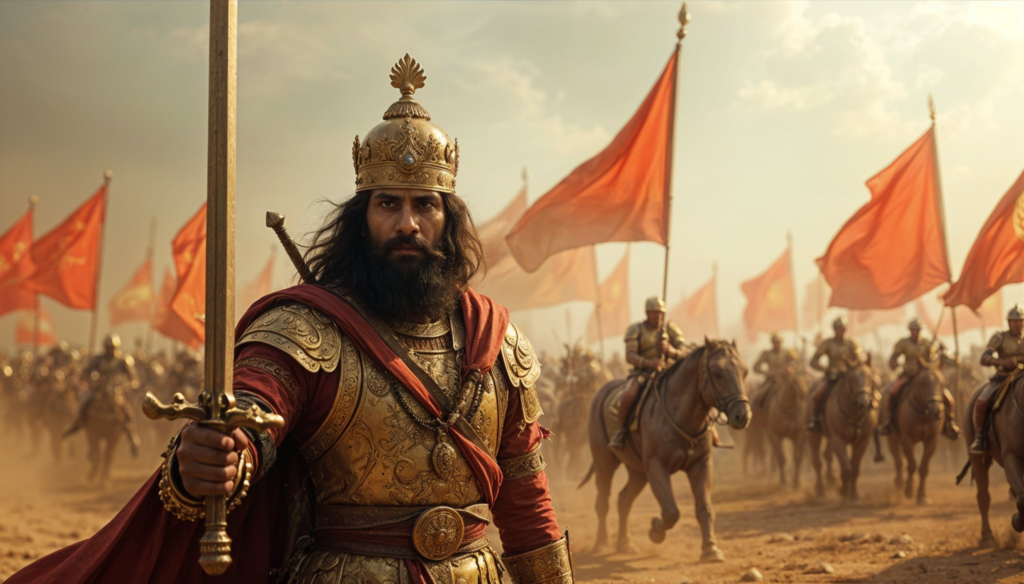

In this blog I’m going to tell you about a Sikh warrior who defeated the Afghans and secured the north-west frontier of India. His name was Hari Singh Nalwa, and this is his untold story.
Who Was Hari Singh Nalwa?
Afghanistan is known as the graveyard of empires, where many powerful invaders have failed to conquer and rule. Many have tried and failed to conquer Afghanistan, including Alexander the Great, the Mighty British, the Soviet Union and very recently even United States. All failed miserably to capture and rule Afghanistan. But do you know that there was a Sikh warrior who did what others couldn’t? He was a general in the army of Maharaja Ranjit Singh, who established the Sikh Empire in early 19th century.
The empire extended from Indus river to Khyber pass, and always faced constant threats from the Afghan tribes and rulers who had been invading India for hundreds of years. He was a brave soldier and an expert in warfare tactics as well as an intelligent administrator. The Afghans feared him so much that mothers in Afghanistan used his name to scare their unruly children. His name was Hari Singh Nalwa, and this is his untold story.
Hari Singh Nalwa was born in 1791 in Gujranwala, now in Pakistan. Born into the Uppal clan of the Khatri caste, he was the son of a wealthy landowner. Educated in Persian, Arabic, and Gurmukhi, Hari Singh Nalwa also learned martial arts and horse riding from a young age. Additionally, he was a devout Sikh who followed the teachings of Guru Gobind Singh, the tenth and last Sikh guru.
He joined the service of Maharaja Ranjit Singh, the founder of the Sikh Empire, when he was just 14 years old. He soon proved his bravery and skill in many battles against the Afghans.
Military Prowess and Expansion of the Maharaja Ranjit Singh’s Empire
When he was just 16 years old, he defeated Afghan ruler Kutab-ud-din Khan in the battle of Kasur in 1807. His courage and ferocity in battle caused him to lose his left eye. Despite his injury, he continued to fight with a patch over his eye.
He earned the title of Nalwa, which means a lion-like person, for his bravery. He also received a jagir, or a land grant, from Maharaja Ranjit Singh for his service.
Later, in 1813, he along with other commanders won against Azim Khan and his brother Dost Mohammad Khan in the battle of Attock. The Sikhs won their first major victory over Durrani Pathans as a result of this victory.
It took place on the banks of the Indus River and ended with the capturing of Attock fort, a very strategic fort which controlled the trade and communication between Punjab and Afghanistan.
Hari Singh Nalwa contributed to this victory in a major way. He strategized and lead an audacious night attack on the enemy’s camp which threw Afghans into complete disarray and panic. Moreover, he also took the governor of Attock as a prisoner and brought him to Maharaja Ranjit Singh as captive.
Hari Singh Nalwa and the Conquest of Peshawar
Nalwa’s army also took control the city of Peshawar in 1818 which was until then the capital of Afghanistan’s Khorasan province. Peshawar was a rich and prosperous city and had always attracted many conquerors.
It was also a cultural and religious centre for the Afghans, with many mosques and shrines within it. Unlike the Muslim invaders who destroyed Hindu Temples once they captured any Hindu administrated city, Nalwa did not damage any of these holy places belonging to the Muslims in Peshawar.
Instead Nalwa deeply respected the local culture and religion. He also strengthened the administration and security of the town in addition to building various public works like roads, bridges, canals, and gardens as well as establishing a mint, court, and police force.
The people of Peshawar loved and admired him and called him ‘Hari Rai,’ the king of Hari.
Hari Singh Nalwa and the Jamrud Fort
One of the most remarkable things Hari Singh Nalwa ever did was building the Jamrud fort at Khyber Pass’ entrance into Afghanistan in 1837.
For centuries, this was a primary route for foreign invaders into India and has been used by invaders like Alexander, Mahmud of Ghazni, Genghis Khan, Timur, Babur and Nadir Shah.
Nalwa decided to build a fort at the mouth of the pass, to prevent Afghans from entering Punjab. He personally supervised the construction of the fort which was completed in record three months.
This fort was named Jamrud which means “the place of gems” and served as Sikh power and prestige symbol.
The Battle of Jamrud: Hari Singh Nalwa’s Final Battle
The fortress infuriated Afghan ruler Dost Mohammad Khan, who regarded it as an aggression on his sovereignty.
To recapture this place, he gathered a 15,000-men strong army and moved towards Jamrud. However, Hari Singh Nalwa at that time was short of soldiers inside the fort and could have retreated back to safety however he was dead against showing back to the enemy and decided to take them head on.
He along with 600 men decided to stay and defend the fort. He sent messages to Maharaja Ranjit Singh for reinforcements but they did not reach early enough.
The Battle of Jamrud took place on April 30th, 1837 and proved one of history’s bloodiest and most savage conflicts.
Despite being outnumbered, Hari Singh Nalwa chose to fight, and his decision paid off because they repulsed their attackers and ensured that their territory and the Jamrud fort remained intact.
Although Nalwa sustained wounds several times, he refused to quit fighting until he died on the battlefield.
His passing away was an enormous setback to Sikhism as well as for India at large. The Afghans could not capture the fort, and had to retreat empty handed.
The fort of Jamrud remained in Sikh hands, until the British annexed Punjab in 1849.
Conclusion: The Legacy of Hari Singh Nalwa
Hari Singh Nalwa’s story is an untold tale of bravery and military strategy that should not be forgotten.
A key figure in the Sikh Empire, he was also a formidable foe for the Afghans. Preventing Afghan entry into Punjab via the Khyber Pass, he blocked the centuries-old route foreign invaders used to enter India.
In addition, he contributed to the development and administration of the regions he conquered, such as Kashmir, Hazara, and Peshawar.
He died in 1837, fighting against the Afghans at Jamrud. The Indian government honored him with a stamp in 2013.